

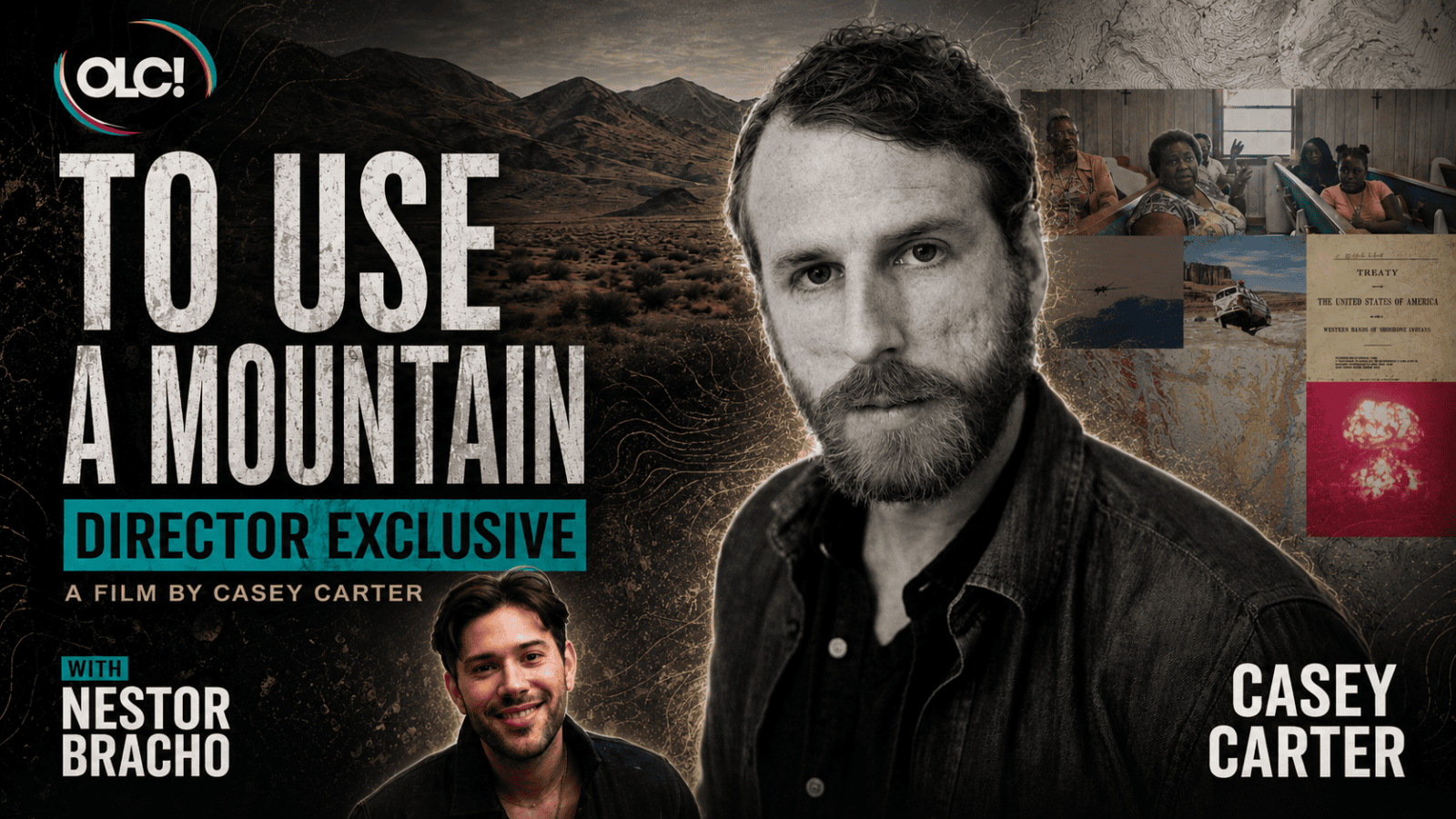
Featuring @c_c_iii @touseamountain @nestorbrachomusic @nyc.egpr
What happens when the government decides the place you call home could become the final resting place for some of the most dangerous material on Earth? Filmmaker Casey Carter explores that question in the acclaimed documentary TO USE A MOUNTAIN and joins OutLoud Culture’s Nestor Bracho for an exclusive conversation about the story behind the film.
In 1982, six rural communities across the United States were forced to confront an almost unimaginable possibility: all of the nation’s high-level nuclear waste could eventually be buried beneath their land.
Not for a decade. Not for a century.
The mandate was to isolate it for 10,000 years.
That staggering premise sits at the heart of filmmaker Casey Carter’s TO USE A MOUNTAIN, a documentary that transforms what could have been a dense story about government policy and nuclear engineering into something far more intimate, a story about home, memory, power, resistance and who gets to decide what happens to a place after generations of people have cared for it.
In an exclusive interview for OutLoud Culture, Nestor Bracho sits down with Carter to take viewers deeper into the film and the extraordinary history behind it.
When a Map Becomes Someone’s Home
After the passage of the Nuclear Waste Policy Act in 1982, the Department of Energy began evaluating locations where high-level radioactive waste could potentially be stored underground.
On paper, they were sites.
On a map, they were coordinates, geological formations and data.
But on the ground, they were people’s homes.
Farmers, miners, Native American communities, activists, citizen scientists and families suddenly found themselves confronting decisions with consequences extending thousands of years into the future.
TO USE A MOUNTAIN deliberately places those human experiences against the detached machinery of institutional decision making.
The result is not simply a film about nuclear waste.
It is about what happens when the language of bureaucracy collides with the emotional reality of belonging somewhere.
And Then There Was Yucca Mountain
Eventually, attention narrowed to Yucca Mountain, a desert ridge in Nevada located on the unceded lands of the Western Shoshone.
For decades, the proposed repository became one of the most controversial environmental and political projects in the country. Construction ultimately stalled, opposition continued and the United States was left with a problem it still has not permanently solved.
America currently has roughly 90,000 tons of high-level nuclear waste — and no operating permanent geological repository for it.
Carter’s film does something particularly effective with that history: rather than treating the communities that resisted these projects as footnotes to a federal process, TO USE A MOUNTAIN makes them the center of the story.
Their landscapes become characters.
Their memories become evidence.
And their resistance becomes part of a much larger question:
Who has the right to decide that one community should carry a burden created by an entire country?
A Story From 1982 That Suddenly Feels Like 2026
Perhaps the most unsettling thing about TO USE A MOUNTAIN is how little of it feels confined to the past.
The United States is once again debating the future of nuclear energy and the infrastructure necessary to support it. New nuclear projects are increasingly being discussed alongside rapidly rising electricity demand including the enormous energy requirements associated with AI and data centers.
And with more nuclear energy inevitably comes the question at the center of Carter’s film:
What happens to the waste?
In July 2026, the Department of Energy named Idaho, Louisiana, Oklahoma, Tennessee and Utah as potential hosts for its Nuclear Lifecycle Innovation Campuses, an initiative involving multiple parts of the nuclear fuel cycle, including used-fuel processing and waste disposition.
The historical parallel is difficult to ignore.
Louisiana is also among the communities whose experience is examined in TO USE A MOUNTAIN.
More than four decades after the events that launched Carter’s story, some of the same fundamental questions about nuclear infrastructure, community consent and long-term responsibility are being asked again.
That timing makes the documentary feel less like an examination of unresolved history and more like a warning that the next chapter may already be beginning.
Casey Carter Turns Policy Into People
Carter approaches the subject from an unusual creative and academic background.
A filmmaker and interdisciplinary designer, he has worked across nonfiction film, photography, data visualization and cartography, with much of his work examining geography, government systems, environmentalism and the relationship between people and place.
He holds degrees in Physics and Photography from Middle Tennessee State University as well as a Master of Architecture from the University of Michigan.
Those different disciplines feel particularly suited to TO USE A MOUNTAIN, a film in which landscapes can simultaneously be homes, ecosystems, political territories, scientific data points and potential repositories.
Carter served as the film’s director, cinematographer and editor, turning years of research and filmmaking into his first feature documentary.
The film premiered at Visions du Réel in Switzerland, where it received the Special Jury Award in the International Competition, and continued its festival run with appearances at Dallas International Film Festival, DOXA, IDFA, Big Sky and others.
The Question TO USE A MOUNTAIN Leaves Behind
There is an easy way to watch a documentary like this: assume it is someone else’s problem.
Some distant desert.
Some rural county.
Some mountain most Americans will never visit.
But TO USE A MOUNTAIN steadily dismantles that distance.
Because every potential location on a government map is somebody’s backyard.
Somebody’s history.
Somebody’s water.
Somebody’s sacred land.
Somebody’s home.
And when the material being discussed may require decisions that outlive not only the people making them, but potentially entire civilizations, the question becomes much larger than where nuclear waste should go.
It becomes a question of what responsibility one generation owes the generations that come after it.
That is where Carter’s film finds its power.
And it is why the conversation surrounding TO USE A MOUNTAIN may be even more relevant now than when production began.
Watch Nestor Bracho’s exclusive conversation with filmmaker Casey Carter above and discover the people, places and unresolved questions behind TO USE A MOUNTAIN.
TO USE A MOUNTAIN opened theatrically at DCTV in New York on August 21, with a regional theatrical expansion to follow. A VOD release through Grasshopper Film is planned for 2027.
Feature Documentary | USA | 2025 | 99 Minutes
Would you support a nuclear waste facility near your community if federal officials said it could be operated safely? Let us know in the comments.





Leave a Reply